



Drugs, Detection and Denial: A Weekend Inside Creamfields
“I’ll do it if you do it, d’you know what I mean”, I heard two boys in the tent next to me say. The ‘it’ in question was ketamine, and the tents were so packed together that I heard the whole exchange before they went off into the night.
It’s a moment that happens constantly at a festival like Creamfields, despite its strict no drug policy and security operations in place at the entrance and on site.
On the gate
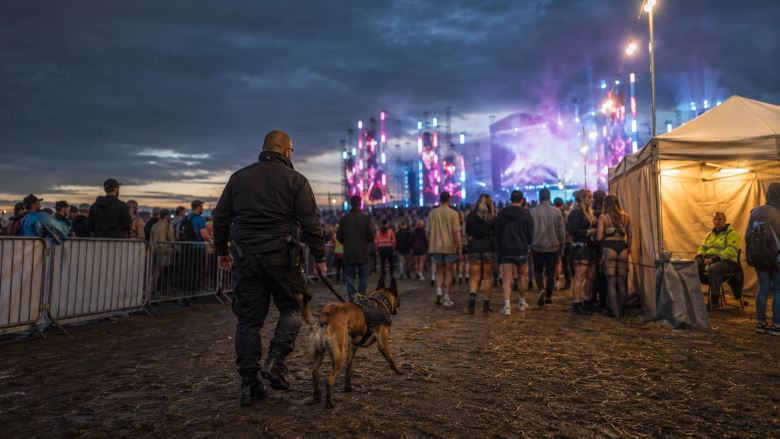
Charlotte Flello has worked in drug detection for five years, alongside her dog Herbie. They're part of the search operation working to stop drugs getting into Creamfields at the front gate. Herbie is trained to detect MDMA, heroin, cocaine, crack cocaine and amphetamines — "pretty much all the major drugs," Flello says
People get caught every year, and the lengths they'll go to hide drugs vary wildly, she says. "We've had people hide it in their cheeks, internally, inside food packaging, sandwiches — any way you can think of, they've tried."
"We get it quite a lot where people go, 'oh, your dog's rubbish,'" Flello says. "We're not going to get everyone that comes into a festival, but the majority of the time they will catch people. It also depends how well the search team are.” When drugs are confiscated, they're placed in amnesty bins and taken to a dedicated tent, where they're tested and disposed of by police.
Herbie's training took him six months to qualify initially, and he and Flello now attend training once a month, alongside an annual re-licensing assessment.
But drug-sniffing dogs and search teams only catch what's carried in on the day. Just days before Creamfields was set to open, officers searching the site found 204 canisters of nitrous oxide, along with bags containing large quantities of MDMA, ecstasy and ketamine buried in the ground. It was a stark reminder of how embedded drug use at festivals is, and the lengths that people will go to for it — not spur-of-the-moment but planned for.
“They Don’t Really Care”
Harry Merson, 19, says he isn't surprised that some people do Creamfields entirely sober, and thinks he'd enjoy himself just as much without alcohol and drugs. "Alcohol's just a bonus kind of thing."
For him, it adds to the social aspects. “You get better vibes and it creates a friendly atmosphere,” he says. He puts the wider drink-and-drug culture at festivals down to circumstance more than anything else. "Young people away from home, friends in that environment where no one's over them, everyone just does it."
When asked about the no-drug policy itself, Merson thinks they’re just trying to prevent a lost cause. “It's always going to happen," he says. "They say it can't happen, but you can look around and people just do it without hiding it. I don't think they care. I think they just try to act like they care or show that they care, but they don't really care."
Cheshire Police reported 186 crimes at Creamfields 2025, the majority drug-related, resulting in 43 arrests. That figure sits alongside research from the University of Liverpool showing up to 87% of festival attendees have tried illegal drugs in their lifetime — more than twice the rate (36%) among young adults generally. If drug use at Creamfields is so expected, where does that leave the people who don’t participate? Navigating a festival that isn't really built with them in mind.
Lottie Openshaw, 18, says it does surprise her that people come to Creamfields and stay completely sober. "I don't have to be drunk, I just need to be a little tipsy to speak to other people," she says. "If I want to branch out from the group I'm camping with, I would probably need a drink or two because it gives me more confidence to talk to others."
However, she still likes to stay in control and is careful about overdoing it. "I've been drunk a couple of times at festivals where I didn't know where my friends were," she says. "If you get sick, everyone sees it, and it's horrible — you can't shower or brush your teeth afterward."
The Welfare Crew
For those who do go too far, there is a safety net. Steve Wood, one of the directors of Events Wellbeing — better known on-site as the Welfare Crew — says alcohol mixed with drugs is a huge part of what they deal with at Creamfields. "There is always one [drug] that comes to mind, especially in the last three to four years, and that would be ketamine," he says. "That has been a trend. We've done nearly 90 events this year, and at the big events, ketamine is always top of the list."
The Welfare Crew look after festivalgoers who are intoxicated but don't need medical treatment, offering a safe space to come down and recover. "That could be anything from a minute to a day or two days — it doesn't matter," Wood says.
Of all the festivals Events Wellbeing works with, he ranks Creamfields among the best for taking welfare seriously. "Creamfields is probably one of the top ones that go over and above every year," he says. "Post-event, they listen, come back to us for more information, take note, and make changes. They strive to make it better each year."
This was seen in action on 29th August when Creamfields sent out a "Stay Safe" alert to attendees, after its onsite testing lab identified pills containing dangerous levels of MDMA that were making people unwell. The message urged anyone concerned or feeling unwell to go straight to the Medical or Welfare tents.
Safety alert sent out via the Creamfields app on Saturday regarding a dangerous pill circulating the festival
Wood has worked in drug and alcohol support for 30 years, and at festivals specifically for 22 of them. "I think every year something different happens, and it makes you realise why we're here. I personally think I've got one of the best jobs in the world. It's a multitude of things that keep me coming back every year."
Safeguarding the youth
For the young people caught with drugs, there's support for them too. Carl Geraghty is an Area Manager for Vibe UK, a wrap-around youth charity working with 11- to 19-year-olds.
Most of what Vibe UK deals with at Creamfields isn't drug use by ticket-holders, but substance misuse and antisocial behaviour on the festival's external perimeter. When security finds juveniles on-site, they're brought to Geraghty's team. "We safeguard them, then contact their parents," he says. "If they're found with contraband, we support them through that."
Vibe UK is the statutory youth service for Halton Borough Council, brought in as a subcontractor by Creamfields because of how many local young people they already work with. "Usually, we already know most of the young people — they're existing service users," he says. "They don't take well to authority, security, or police, but they respond better to a trusted adult, a youth worker, or a social worker."
The young people they see skew heavily male, and most have come in over the fence rather than through the gate. Ages range widely. "In previous years we've had anyone from 11 years old up to 19," Geraghty says. "It's a mixed bag."
What's clear is that nobody's pretending drugs and alcohol aren't part of Creamfields — the whole operation is built around that fact. It just means that when things go wrong, someone's there to help, and that's one thing Creamfields have got right.
forum Join the Discussion
Sign in to joinNo comments yet
Be the first to weigh in.