



If the mark of a top festival is leaving you wanting more, then Womad sits at the pinnacle. I almost wept at the thought of waiting a whole year until the next one as I left its beautiful new venue. Okay, it’s far from the wildest of festivals (in many ways it’s rather sedate), but it has a wholesome charm and the warmest of hearts that get right under your skin. It’s not only me who’s hopelessly addicted – many attendees have been coming along every year for decades.
In terms of its artists, Womad is the most diverse and international festival of the year by a country mile. This sun-drenched year, the choice across its six main stages was jaw-dropping. If you could die from FOMO, I’d be six feet under by now.
My cunning tactic was to hang out at the intimate Taste the World stage, now in its 20th year, where many of the festival’s top performers come along and cook a dish from their home country and sing a few of their songs. It’s like an informal gig in your kitchen, assuming your kitchen fits a couple of hundred people. Highlights included fado star Gisela João (she was lovely), Ukrainian experimental folk singer Ganna (such a haunting voice), Korean bluegrass band (yes, you heard me right) Country Gongbang, the magnificent K.O.G. (whose high-octane Afrobeat Big Top gig kicked the festival off), and irrepressible Peruvian band Big Pollo who had everyone dancing like maniacs. Ditto Haitian Creole star Wesli.
It didn’t feel right, though, to spend the whole of the long weekend in the kitchen. After all, where would that leave my macho credentials? As it happens these credentials took a final death blow from Wild Wild Women in the Big Top, an astoundingly fabulous Mumbai hip-hop band, whose stated mission is to smash the patriarchy. I’m all for it. Pass me my apron. Talking of hip hop, another huge highlight was the understandably rage-fuelled Palestinian artist Tamer Nafar, whose passionate set left me in tears. I could go on, and on, but let’s avoid too much of a list.
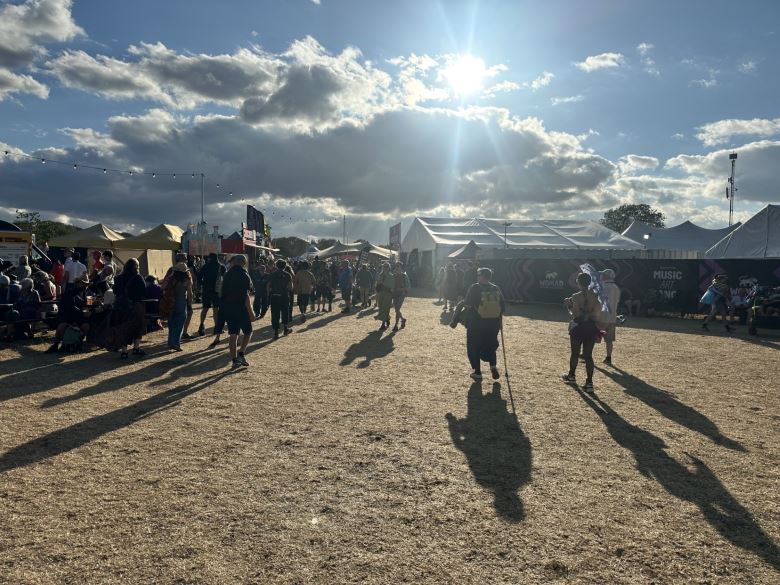
The new Neston Park venue somehow underscored this festival’s non-commercial, right-on, eco-conscious roots. Its relatively compact layout gave proceedings a bustling village vibe and reinforced the sense of a community looking out for one another. The age range is primarily over 40, albeit there’s a good number of teens and twenty-somethings around, not least in the late-night dance venues and at a far-flung tent where young musicians received expert feedback on their performances.
Womad is also a fantastic place to bring your small kids. The World of Children had all sorts of fun and creative activities going on throughout the weekend, as the festival’s traditional Sunday procession demonstrated. The costumes, creations and proud young smiles were wonderful and heartwarming.
While not a problem, of course, with Womad’s extraordinarily diverse line-up (and MCs) it does feel somewhat paradoxical that the crowd is mainly white. Is world music really such a white thing in the UK? It certainly shouldn’t be, and my feeling is this will change before too long.
Moving on to a gripe: why is it that some people insist on planting their camping chairs right in the middle of the main venues and then resolutely refuse to move throughout packed performances? They can’t see the performers for the crowd, and the sound is just as good at the surrounds. It made me – humph! – a little cross. I decided to channel this middle-class fury into my remarkable repertoire of dance moves though, rather than say something and risk causing a grey-haired rumpus. Nonetheless, it’d be handy if the festival actively discouraged this heinous chair crime.
The variety of stalls is top-notch at Womad, with lots of interesting crafty things, a regularly restocked Oxfam tent (another addiction), and loads of excellent food outlets. Top dog is undoubtedly the Madras Café, a Womad charity institution along with Oxfam and Amnesty International. The café is pricey (festival prices have shot up), but its steaming hot chai is the best I’ve tasted outside India.
What else? Oh yes, I stumbled across a fantastic natural voice singing workshop one morning and blessed its participants with my nightingale tones, and I explored – but didn’t partake in – the extensive World of Wellness area. I have a weakness for a gong bath and a smudging, but (and I hate to admit it as an alternative type) yoga just doesn’t turn my crank. Om shanti.
Well worth mentioning is the number of disabled people in attendance. It felt genuinely inclusive, with a great deal of thought clearly having gone into making the festival accessible. Top marks.
Womad also puts on more cerebral activities for those of us not too wasted and/or too knackered to concentrate for more than a couple of minutes. I went to two discussions in the Byline Times-run World of Words tent: The Role of Journalism in a World of Social Media and Untruth; and The Lure of Spirituality for the Far Right. It should’ve been religion rather than spirituality, but hey, both talks were thought-provoking. I only had so much brain space for intelligent pursuits, though, and I’m ashamed to say I didn’t linger at all at the ever-busy Poetry Shack.
I didn’t go on any of the foraging walks either. Or take part in a whole heap of other potentially fascinating things. Having said that it’s easier for my post-festival FOMO if I don’t dwell too much on what I’ve missed, so I won’t, thank you.
What I will think about – with a sense of love and longing – are the wonderful four days I spent at Neston Park. It was my favourite Womad to date. I hope there will be many more to come.
forum Join the Discussion
Sign in to joinNo comments yet
Be the first to weigh in.