


Tindersticks
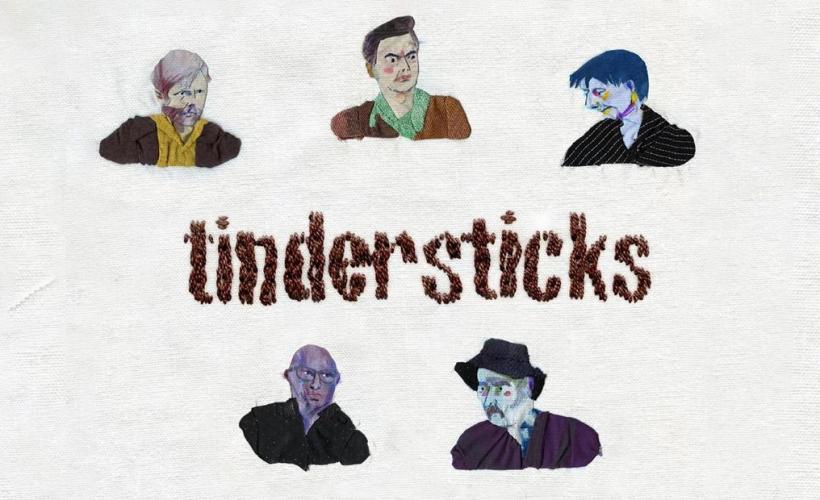
Tindersticks are an English indie rock group from Nottingham, United Kingdom, active from 1991. The line-up includes Stuart A. Staples, David Boulter, Neil Fraser, Dickon Hinchliffe, Alasdair de Villeneuve Macaulay, Mark Colwill and Earl Harvin. The band forms in late 1991 from former members of Asphalt Ribbons, and adopts the name Tindersticks after Stuart A. Staples finds a box of German matches on a Greek beach.
Style and instrumentation
The group develops a sound built from orchestral backing, lounge jazz and soul, with chamber pop, ambient, art rock, blue-eyed soul, jazz pop and indie rock elements. Staples’ baritone voice and Hinchliffe’s string arrangements are central features. Their recordings also make extensive use of electric guitar, Rhodes piano, glockenspiel, vibraphone, violin, trumpet, trombone, clarinet, bassoon and Hammond organ, among other instruments.
Early releases and critical reputation
Tindersticks begin recording demo tapes in 1992 and sign to Tippy Toe Records, which releases their first single, “Patchwork”. Their first two self-titled albums establish their sound and receive wide critical acclaim. The band builds a cult following in the United Kingdom and continental Europe, while remaining outside the mainstream.
The live album Bloomsbury Theatre 12.3.95 documents one of their performances with large string sections and, at times, a full orchestra. By the third album, Curtains, the songs show a change in direction, and the lengthy “Ballad of Tindersticks” reflects the pressures of touring.
Later studio albums
Simple Pleasure moves towards a lighter, more soul-influenced style, with female backing vocals on several tracks and a cover of Odyssey’s “If You’re Looking For A Way Out”. Can Our Love continues that soulful direction, including “Sweet Release” and “Chilitetime”. Waiting For The Moon is more stripped down and introspective, with “4.48 Psychosis” based on the Sarah Kane play of the same name and “Sometimes It Hurts” among its more sombre songs.
After a period in which Staples pursues a solo career and there is speculation about the group’s future, the band reconvenes for a concert at London’s Barbican Centre in September 2006, where they perform their second album in full with a nine-piece string section and two brass players, including Terry Edwards on trumpet. A new recording process in 2007 leads to The Hungry Saw, released in 2008 on Beggars Banquet. The album is recorded in a new studio in Limousin, France by a reduced core of Staples, Boulter and Fraser, joined by Thomas Belhom on drums and Dan McKinna on bass, with Ian Caple engineering.
In 2010 the band releases Falling Down a Mountain on 4AD and Constellation Records, with Earl Harvin replacing Belhom on drums and David Kitt joining on guitar and vocals. The Something Rain follows in 2012. Tindersticks also release commissioned soundscapes from the In Flanders Fields First World War museum in Ypres, Belgium.
Film, television and other work
Tindersticks compose soundtracks for four films by Claire Denis: Nenette et Boni, Trouble Every Day, 35 Rhums and White Material. They also record a cover of the Four Tops song “What Is A Man” for the theme to the television series The Sins. Their song “Tiny Tears” appears prominently in an episode of The Sopranos, “Running Wild” is used in the ending credits of “The Blue Comet”, and “El Diablo En El Ojo” is used twice in the first-season finale of Brotherhood.
forum Join the Discussion
Sign in to joinNo comments yet
Be the first to weigh in.