

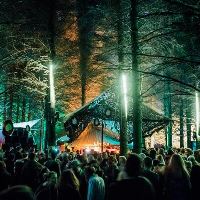


Pain of Salvation
Pain of Salvation is a Swedish progressive metal band from Eskilstuna, Sweden, active since 1991. The group is led by Daniel Gildenlöw, who acts as its main songwriter, lyricist, guitarist and vocalist. Its line-up has included Mikael Pettersson, Joakim Strandberg, Daniel Gildenlöw, Daniel Magdic, Johan Langell, Magnus Johansson, Gustaf Hielm, Kristoffer Gildenlöw, Fredrik Hermansson, Johan Hallgren, Simon Andersson, Léo Margarit, Daniel Karlsson and Ragnar Zolberg.
Style and themes
The band plays progressive metal and progressive rock with riff-based guitar work, a wide vocal range, abrupt shifts between heavy and quieter sections, complex vocal harmonies, and frequent use of syncopation and polyrhythms. Its lyrics often deal with sexuality, war, environmental issues, and philosophical questions about God, humanity and existence.
Early history
The group first begins as a project called Reality, formed by Gildenlöw when he is eleven. It takes the name Pain of Salvation in 1991, with the name presented as a balance of positive and negative experiences and as a metaphor for setbacks on the way to a goal. In 1987, Reality appears in the Swedish competition Rock-SM, where Gildenlöw receives an award for best vocalist. Daniel Magdic is part of the early line-up and remains with the band until 1997. Drummer Johan Langell and bassist Gustaf Hielm join in 1990.
Albums and development
Kristoffer Gildenlöw replaces Hielm on bass in 1994, and the group records the demo Hereafter, which leads to the arrival of keyboardist Fredrik Hermansson. The debut album, Entropia, is recorded in 1997 and first released in Asia before later reaching Europe and South America. It gains attention for its variety and production. After Magdic leaves, Johan Hallgren joins on guitar.
The second album, One Hour by the Concrete Lake, appears in 1998 and explores nuclear waste, indigenous rights and warfare through more complex structures and darker themes. The Perfect Element, Part I follows in 2000 as a concept album about psychological development from adolescence to adulthood. Remedy Lane arrives in 2002 as a semi-autobiographical album centred on relationships and personal experience.
Concept work, changes and later releases
In 2004, the band releases 12:5, an acoustic recording of reworked earlier material, and BE, an extensive concept album about theology and human existence. BE is developed over several years and performed live before its studio release; critical reaction is mixed. Between 2004 and 2013, the band does not perform in the United States because of Gildenlöw’s objections to the entry policies then in place. Kristoffer Gildenlöw leaves in 2006.
Scarsick follows in 2007 and continues themes from The Perfect Element, Part I. The band then goes through further line-up changes, including the departure of Langell and later Simon Andersson. Road Salt One and Road Salt Two, released in 2010 and 2011, mark a stylistic shift toward loosely connected narratives rather than a single linear concept. Around this period, the band takes part in Melodifestivalen with the song Road Salt but does not reach the final.
Gustaf Hielm returns and Ragnar Zolberg joins between 2011 and 2012. Falling Home appears in 2014 as an acoustic album with reinterpretations of older songs and new material. Gildenlöw is hospitalised with a severe bacterial infection, and that experience shapes In the Passing Light of Day in 2017. The band also revisits Remedy Lane with a remixed edition and a full live performance release. Panther is released in 2020, preceded by the single Accelerator, and it continues the band’s conceptual approach while marking Hielm’s departure.
forum Join the Discussion
Sign in to joinNo comments yet
Be the first to weigh in.