


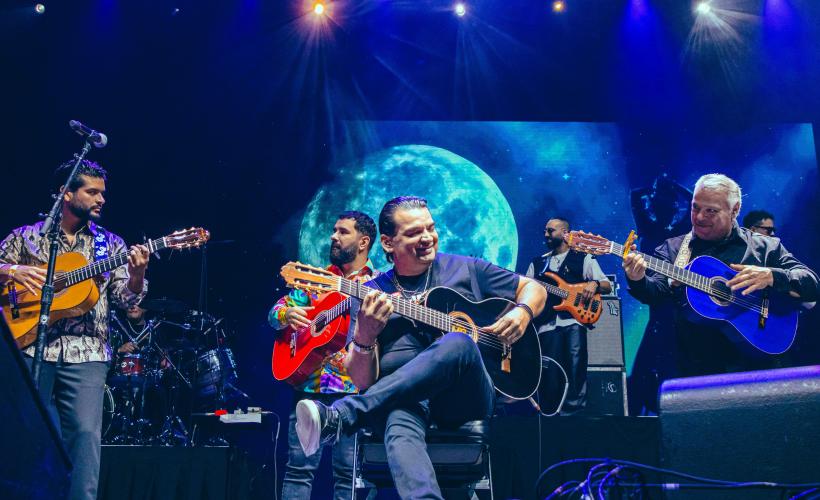
Gipsy Kings
Gipsy Kings is a flamenco and latin music group from Arles, France, active since 1978. The group also has links to Montpellier, and its core identity comes from two related families, the Reyes and the Baliardos. Their name reflects the family connection: Reyes means “kings” in Spanish.
Origins and early development
The group grows out of a Roma musical family tradition. Nicolas, Canut and Paul Reyes perform with their father, the flamenco singer Jose Reyes, who sings cante jondo, the deep, traditional form of flamenco associated with themes such as passion, love and death. The younger generation begins to move towards rumba flamenca, and the band explains that this shift comes from a desire to make music for dancing. Before recording under the Gipsy Kings name, they play at Roma gatherings and on street corners.
The line-up later expands through the Baliardo family, with three guitar-playing brothers joining the Reyes brothers. The group’s members include Nicolas Reyes on lead vocals and guitar; Paul, Canut, Patchaï and André Reyes on backing vocals and guitar; Diego and Paco Baliardo on guitar; and Tonino Baliardo on lead guitar. Jahloul “Chico” Bouchikhi is also a member, but leaves after the album Mosaique. Other listed members include Marc Chantereau, Dominique Perrier, Gérard Prévost, Claude Salmiéri and El Rumbero.
Style and sound
Gipsy Kings build a style based on flamenco guitar, rumba rhythms and pop-oriented songwriting. Their music combines Latin American beats, percussive guitar techniques and rhythmic hand-clapping, while also drawing on dance, folk, flamenco pop and world music influences. The group also uses drum kits, electronic bass, electronic keyboards, and rock and reggae rhythms, which leads to criticism from flamenco purists and support from listeners who see the band as helping to form a new style.
Several members are left-handed and play right-handed guitars turned upside down, a practical result of growing up without their own instruments.
Recordings and recognition
Their self-titled debut album brings them broad popularity and includes “Djobi Djoba”, “Bamboleo” and the ballad “Un Amor”. Their second album, Mosaique, includes “Volare”, a rumba version of Domenico Modugno’s “Nel Blu Dipinto Di Blu”. The album Gipsy Kings later appears in the United States and stays on the charts for 40 weeks, which is unusual for a Spanish-language album.
The group’s cover of “Hotel California” becomes one of their best-known recordings and appears in The Big Lebowski. In 1991 they provide flamenco guitar and backing vocals on Bananarama’s version of “Long Train Running” under the name Alma de Noche, and they also contribute a rumba flamenca version of “I’ve Got No Strings” for the compilation Simply Mad About the Mouse.
The 1993 album Love and Liberte wins the Latin Grammy Award for Best Pop Album of the Year and includes “Montana”, a song about Roma being forced from their homeland. The 1995 compilation The Best of the Gipsy Kings goes platinum and remains on the charts for more than a year. Other albums that go gold include Mosaïque, Allegria, Este Mundo, Gipsy Kings Live, Love & Liberte, Tierra Gitana, Cantos de Amor and Volare! - the Very Best of the Gipsy Kings.
The group’s total album sales exceed 18 million worldwide, and they are described as the best-selling music group from France in history.
Related projects
Tonino Baliardo, who writes the group’s instrumentals, also releases solo albums: Essences in 2001 and a self-titled album in 2003. The group’s story is also explored in the 1996 PBS documentary Tierra Gitana (Gipsy Land).
forum Join the Discussion
Sign in to joinNo comments yet
Be the first to weigh in.