


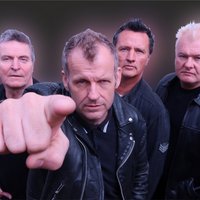
Eddie & The Hot Rods
Eddie & The Hot Rods are a British pub rock, punk rock and power pop group from Southend-on-Sea, active from 1975 to the present. They begin in 1973 under the name Buckshee and rehearse in drummer Steve Nicol’s garage in Rochford, Essex. The early line-up includes bassist Rob Steel, who is known by the nickname “The Hustler”, and guitarist Dave Higgs, whose arrival leads to the name Eddie and the Hot Rods.
Early years and line-up changes
By 1975, the group starts playing the London pub rock circuit. Their music is rooted in energetic R&B and is influenced by The Who, The Kinks, Dr Feelgood and Graham Parker & the Rumour, as well as Chicago blues and soul covers. The band’s early personnel changes are frequent. Barrie Masters is the vocalist, with Pete Wall and Dave Higgs on guitar, Rob Steel on bass and Steve Nicol on drums. “Eddie”, the dummy used in the band’s early stage act, is later dropped when the joke wears thin.
Ed Hollis, brother of Talk Talk’s Mark Hollis, becomes their manager and the band sign to Island Records. By 1976, Lew Lewis on harmonica and Paul Gray replace Wall and Steel. Lewis appears on the first two singles before leaving.
Breakthrough recordings
With the new line-up, the group plays at the Marquee in London with a young Sex Pistols as support. They enter the UK singles chart at the end of 1976 with the Live at the Marquee EP and the single “Teenage Depression”. Their album Teenage Depression brings their first UK albums chart entry. They also record the Live - At the Sound Of Speed EP. Graeme Douglas, formerly of the Kursaal Flyers, joins onstage during the recording gig, later becomes a permanent member, and adds lead guitar parts in the studio.
Douglas shifts the band towards a more radio-friendly sound. Their biggest hit is “Do Anything You Wanna Do”, credited to Douglas and Hollis and released under the shortened name The Rods. It reaches number 9 in the British chart in August 1977 and also connects with punk audiences. That same year they release Life on the Line and tour the Americas.
Later career
The follow-up album Thriller does not repeat the success of “Do Anything You Wanna Do”. The band are dropped by their record company in 1979 and disband in 1981 after the EMI release Fish’n’Chips. By then Gray and Douglas have already left; Gray joins The Damned, while Masters later works with The Inmates. Ed Hollis goes on to work with The Damned, Elvis Costello and Stiff Little Fingers.
The group reform in 1985 with Masters and Nicol joined by Warren Kennedy on guitar and Russ Strutter on bass, and issue a single and a live mini-album before this version ends after a couple of years. In early 1991, the “classic” line-up of Masters, Nicol, Higgs, Douglas and Gray reunites for live dates. In the mid-1990s, Masters, Gray and Nicol record Gasoline Days with Mick Rodgers of Manfred Mann. In 2005, a Masters-led line-up records Better Late than Never for a 30th anniversary tour. The band continues to tour regularly in Europe and also performs in the United States after a long break.
forum Join the Discussion
Sign in to joinNo comments yet
Be the first to weigh in.