


The Pogues
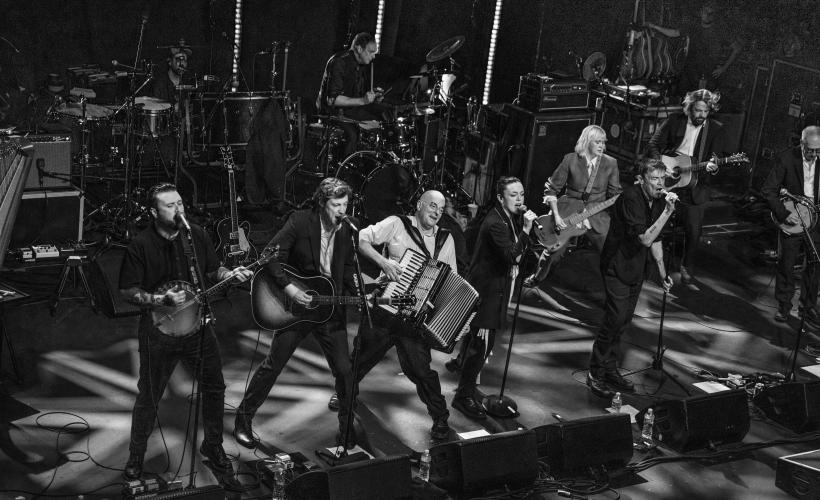
The Pogues are an Irish-British Celtic punk group from London, active from 1982 to 2014. They form around Shane MacGowan, James Fearnley and Spider Stacy, with Jeremy Jem Finer, Cait O’Riordan and Andrew Ranken joining early in the band’s development. Other members across the group’s history include Terry Woods, Phil Chevron, Darryl Hunt, Joe Strummer, James McNally, Jamie Clarke and David Coulter.
Style and early years
The band begins in King’s Cross in north London, initially using the name Pogue Mahone before shortening it. Its music combines Irish folk with punk energy, and its line-up uses traditional instruments such as tin whistle, banjo, cittern, mandolin and accordion alongside electric guitar in later periods. Their political edge and street-level approach link them to punk and to The Clash, with whom they play.
Shane MacGowan, James Fearnley and Spider Stacy start out busking in London before the fuller group takes shape. The Pogues build an early reputation through independent releases and support The Clash on tour in 1984.
Albums and key songs
Their first album, Red Roses for Me, appears in 1984 and draws heavily on MacGowan’s earlier punk background with The Nipple Erectors, later known as The Nips. In 1985 they issue Rum Sodomy & the Lash, recorded with help from Elvis Costello. That album includes songs such as “The Sick Bed of Cúchulainn” and “The Old Main Drag”, alongside interpretations of “Dirty Old Town” and “And the Band Played Waltzing Matilda”. Its artwork reworks Géricault’s The Raft of the Medusa with band members’ faces.
After Cait O’Riordan leaves and Darryl Hunt replaces her on bass, the band adds Terry Woods and records If I Should Fall from Grace with God in 1988 and Peace and Love in 1989. These albums reach the UK top five. If I Should Fall from Grace with God includes “Fairytale of New York”, a Christmas duet with Kirsty MacColl that becomes one of their best-known recordings. Later releases include Hell’s Ditch, Waiting for Herb, and Pogue Mahone.
Waiting for Herb contains “Tuesday Morning”, their third and final UK top twenty single and their best-selling single internationally. The band also issues several compilations, including The Best of The Pogues, The Rest of the Best, The Very Best of The Pogues and The Ultimate Collection including Live at the Brixton Academy.
Line-up changes and later activity
MacGowan leaves in 1991 because of drinking problems. Joe Strummer then handles vocals for a time before Spider Stacy takes over permanently. The group breaks up in 1996 with three members remaining. MacGowan forms Shane MacGowan and The Popes in 1994, while Stacy, Andrew Ranken and Darryl Hunt briefly play together as the Vendettas.
The Pogues reunite in 2001, including MacGowan, for a Christmas tour and continue to play intermittently. In the 2000s and 2010s they tour the UK, US, Europe and Japan, including a six-city US tour titled A Parting Glass with The Pogues in 2011 and a 30th Anniversary European Tour in 2012.
Recognition
The group gains international prominence in the 1980s and early 1990s and is credited with inventing Celtic punk, with a wider influence on Celtic fusion. They receive the lifetime achievement award at the Meteor Ireland Music Awards in 2006. “Fairytale of New York” also becomes a major seasonal standard and is voted the greatest Christmas record in a public poll.
forum Join the Discussion
Sign in to joinNo comments yet
Be the first to weigh in.