



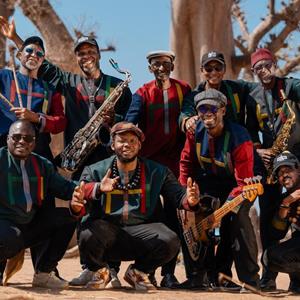
Orchestra Baobab
Orchestra Baobab is a Senegalese band formed in Dakar in 1970. It begins as a multi-ethnic, multi-national club band built around a cosmopolitan line-up and a blend of Afro-Cuban, Caribbean and West African styles. The group is assembled by saxophonist Baro N’Diaye, and its early members include singers Balla Sidibe, Rudy Gomis and Laye Mboup; guitarists Barthelemy Attisso and Latfi Ben Geloune; bassist Charlie N’Diaye; drummer Mountaga Koite; and saxophonist Issa Cissokho. Ndiouga Dieng and Medoune Diallo sometimes sit in with the band, and the line-up changes frequently over time. Later, Thione Seck and his younger brother Mapenda Seck join as singers.
Style and early years
The band develops a distinctive sound that mixes Cuban-influenced rhythms with Senegalese material, especially harmonies and drumming associated with Casamance in southern Senegal. It also draws on Wolof influences from northern Senegal, and on melodies from Togo and Morocco. This mixture gives the group a reputation as one of Senegal’s most versatile and cosmopolitan bands. The club and the band both take the name Baobab.
In its early period, Orchestra Baobab becomes a major Dakar attraction and records more than 20 vinyl albums between 1970 and 1985. Early recordings include local hits such as “Ni Diaye”. Laye Mboup’s Wolof-led vocals shape the group’s first phase, but he dies in a car crash in 1974, after which Balla Sidibe and Rudy Gomis take on more of the lead vocals alongside Ndiouga Dieng and occasional guest singers.
Key recordings and recognition
By 1982 the band records what becomes its best-known album, Pirates Choice, originally tracked during those sessions and later reissued with extra rare material. It becomes widely admired outside Senegal and helps establish the group internationally. Other notable songs associated with the band include “Utrus horas”, “On verra ça”, “Autorail”, “Sutukun”, “Coumba”, “Bul Ma Miin”, “Bamba”, and “El son te llama”.
Competition from mbalax, which becomes dominant in Senegal in the mid-1980s, reduces the band’s audience. By 1987 the group has broken up. Reissues in Europe bring renewed attention, leading to a reunion in 2001.
Reunion and later work
The reunited band tours Europe and records again with guest appearances from Cuban singer Ibrahim Ferrer and Senegalese artist Youssou N’Dour. In 2002 it releases Specialist in All Styles, produced by Youssou N’Dour and recorded in London with Jerry Boys. The album features new material alongside older songs, including “Ndongoy daara”, “Gnawoe” and a new version of “El son te llama”.
In 2003 Orchestra Baobab draws wider American attention through the VH1 documentary Trey and Dave go to Africa, in which Trey Anastasio and Dave Matthews visit Senegal and perform with the group. The band also plays Live 8 in Johannesburg. Specialist in All Styles wins two BBC Radio 3 Awards for World Music in 2003, taking the Africa category and the Critics Award for Album of the Year, and it is also nominated for a Grammy in the Best Contemporary World Music category.
In October 2007 the band releases Made in Dakar on World Circuit Records. In 2009 it issues La Belle Epoque, a double album of earlier recordings from the 1970s, including material from Club Baobab in Dakar and original recordings made in 1978 for Baobab à Paris, its first European recordings. The release includes a biography by Pierre René-Worms and versions of songs by Medoune Diallo and Balla Sidibé.
Recent line-up and legacy
After departures and the death of Ndiouga Dieng in November 2016, the band continues under Balla Sidibe’s leadership. It releases Tribute To Ndiouga Dieng in 2017 and tours internationally. Orchestra Baobab remains associated with the blend of Cuban dance rhythms, Casamance traditions and urban Senegalese styles that defines its place in West African popular music.
forum Join the Discussion
Sign in to joinNo comments yet
Be the first to weigh in.