
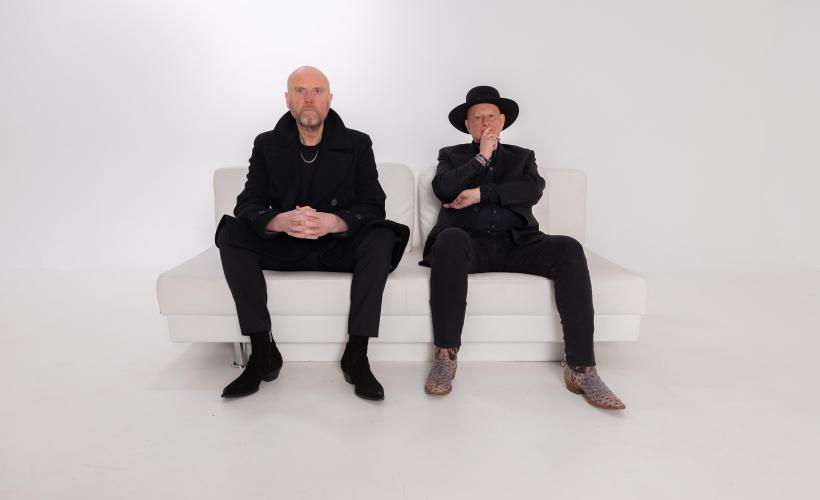
Heaven 17 is a British synthpop band originating in Sheffield, South Yorkshire, England that was formed in 1980, having much 80s success with their electronic sound. Taking their name from a fictional group mentioned in Anthony Burgess's novel A Clockwork Orange (where 'The Heaven Seventeen' are at number 4 in the charts with 'Inside'), Heaven 17 formed when Ian Craig Marsh and Martyn Ware split from their earlier group, The Human League, and devised the production company British Electric Foundation (B.E.F.).
Shortly after, they recruited their good friend and photographer Glenn Gregory on vocals to complete their lineup for Heaven 17. Contrary to popular belief, they were not 'New Romantics' per se and had different visual characteristics than groups such as Spandau Ballet and the Culture Club. Like The Human League, Heaven 17 heavily used synthesizers and drum machines while taking influence from the minimalist electronica music of the 70s.
They had a few minor hits in their early days, including the song "Play To Win" that featured on the album 'Penthouse and Pavement'. Their debut single '(We Don't Need This) Fascist Groove Thang' from the same album attracted some attention, became a left-wing anthem for a while, and was banned by the BBC because of its overtly political lyrics, but it still reached number 45 in the UK singles chart.
Major chart success eluded them until the single 'Temptation' (in which they were augmented by the vocalist Carol Kenyon) reached number 2 in the UK charts in summer 1983. Other songs from the same album, The Luxury Gap, also charted though not as high - 'Come Live With Me' reached number 5 in the UK, 'Crushed By The Wheels Of Industry' reached number 17, and 'Let Me Go', reaching 41 in November 1982. The album itself charted at their best ever position, number four.
At the end of 1983, the band helped re-launch Tina Turner's solo career, producing and providing backing vocals on her debut hit 'Let's Stay Together'. 1984 featured the release of the moderately successful How Men Are, which reached number 12.
The band also worked on the Band Aid single at the end of 1984, with Gregory supplying vocals alongside Midge Ure and Sting. However, they did not perform at Live Aid the following year.
Pleasure One (featuring the single 'Trouble') appeared in 1986 and it was followed up in 1988 with Teddy Bear, Duke & Psycho (featuring the single 'Train Of Love In Motion'). The early 90's were a quiet period for the band and they wouldn't work together as Heaven 17 until 1996's Bigger Than America. In the preceding years, Marsh and Ware produced a second B.E.F. album to 1981's original Music of Quality and Distinction and Gregory formed the band Ugly. Ware became an in-demand producer, working for the likes of Terence Trent D'Arby, Alison Moyet and Erasure. 2005 saw the release of the long-awaited Before After; the album having a much more contemporary dance sound compared to previous albums.
Share
Biography
Buy Tickets
Past Appearances
- 2021 4 Sep 2021
- 2021 6 Aug 2021
- 2021 6 Aug 2021
- 2021 31 Jul 2021
- 2021 26 Jun 2021
- 2020 7 Aug 2020
- 2020 31 Jul 2020
- 2020 25 Jul 2020
- 2020 20 Jun 2020
- 2019 7 Sep 2019
- 2019 16 Aug 2019
- 2019 10 Aug 2019
- 2019 2 Aug 2019
- 2018 17 Aug 2018
- 2018 3 Aug 2018
- 2018 20 Jul 2018
- 2018 23 Jun 2018
- 2018 9 Jun 2018
- 2018 26 May 2018
- 2016 13 Aug 2016
- 2016 2 Jul 2016
- 2016 28 May 2016
- 2015 28 Aug 2015
- 2015 11 Jul 2015
- 2015 12 Jun 2015
- 2014 18 Jul 2014
- 2013 2 Aug 2013
- 2013 1 Aug 2013
- 2012 28 Jul 2012
- 2012 13 Jul 2012
- 2011 29 Jul 2011
- 2010 9 Sep 2010
- 2010 20 Aug 2010


Discussion
Sign in to joinNo comments yet
Be the first to weigh in.