


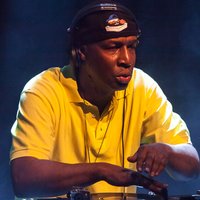
Grandmaster Flash
Grandmaster Flash is the stage name of Joseph Robert Saddler, a hip hop DJ from Bridgetown, United States, born in 1958. He is regarded as one of the key pioneers of hip hop DJing and is closely associated with the development of the “Quick Mix Theory”, a turntable method that uses duplicate vinyl records to extend drum breaks. His work also helps establish techniques such as cutting, scratching, beat juggling and backspinning, and is linked with the invention and wider use of the slipmat.
Early life and technique
Saddler is raised in the Bronx, New York City, in a family of Barbadian origin. He attends Samuel Gompers High School, where he studies electronics and learns to repair electronic equipment. His interest in music comes in part from his father’s record collection, which includes Caribbean and African American music, while his technical knowledge feeds into his later DJ experiments. After leaving school, he becomes involved in New York’s early DJ scene and attends performances by DJs including DJ Kool Herc and Disco King Mario. His uncle is former featherweight boxing champion Sandy Saddler.
He develops the Quick Mix Theory in the Bronx by experimenting with turntables and mixers. The method lets DJs lengthen short instrumental breaks by switching between two identical records, creating a continuous rhythmic loop. He also refines the use of cueing with headphones, crossfader techniques, and backspinning. His experiments with felt and wax paper between the record and platter lead to the development of the slipmat, and he promotes spherical styluses for repeated backspinning. Other techniques associated with him include punch phrasing, and he helps popularise and develop scratching as a live performance technique.
Grandmaster Flash and the Furious Five
Grandmaster Flash forms Grandmaster Flash & the 3 MCs with Cowboy (Keef Cowboy), Melle Mel (Melvin Glover) and Kidd Creole (Nathaniel Glover). Cowboy is widely credited with introducing the term “hip hop” in stage performances. The group later expands with Rahiem and Scorpio and becomes Grandmaster Flash and the Furious Five. They are known for MC performances and freestyle battles and hold a regular residency at Disco Fever in the Bronx.
The group signs to Enjoy Records and releases the debut single “Superrappin’” in 1979 before moving to Sugar Hill Records in 1980. Their best-known recording is “The Message” (1982), which addresses urban poverty, crime and drug use. The record is preserved in the National Recording Registry and is the first hip hop recording to receive that distinction. Although Grandmaster Flash’s name appears on the track, he does not perform on it, which instead features Melle Mel and session musician Duke Bootee. He is also absent from several other recordings credited to the group, whose studio work often relies on live musicians rather than turntable performance.
Solo work and later career
His solo recording “The Adventures of Grandmaster Flash on the Wheels of Steel” (1981) shows his turntable technique by combining excerpts from several recordings into a continuous mix. After disputes with Sugar Hill Records over royalties, he leaves the label with Kidd Creole and Rahiem and records under the name Grandmaster Flash for Elektra. Melle Mel and the remaining members continue as Grandmaster Melle Mel & the Furious Five.
His solo studio albums include They Said It Couldn't Be Done (1985), The Source (1986), Ba-Dop-Boom-Bang (1987), Flash Is Back (1998) and The Bridge (Concept of a Culture) (2009). He appears in the film Wild Style (1983), is interviewed in the documentary Big Fun in the Big Town (1986), and later appears in the documentary series Hip-Hop Evolution.
Awards, honours and collaborations
The original group reunites for a charity concert in 1987, releases another album in 1988, and reunites again in 1994 after the death of Cowboy in 1989. In 1999, Grandmaster Flash collaborates with DJ Tomekk and Flavor Flav on “1, 2, 3, ... Rhymes Galore”, which reaches the top ten of the German singles chart. In 2006, he receives the BET “I Am Hip Hop Icon” award and hosts the weekly radio programme Friday Night Fire with Grandmaster Flash on Sirius Satellite Radio. In 2007, Grandmaster Flash and the Furious Five become the first rap act inducted into the Rock and Roll Hall of Fame. In 2019, he becomes the first hip hop artist to receive the Polar Music Prize. He receives honorary doctorates from Buffalo State University in 2022 and Lehman College in 2023, and New York City proclaims August 4 as Grandmaster Flash Day in August 2023.
Other appearances and media
He publishes the memoir The Adventures of Grandmaster Flash: My Life, My Beats in 2008, reflecting on his early interest in records, electronics and technical experimentation. He appears as a playable character in DJ Hero, and the 2016 Netflix series The Get Down includes a fictionalised version of him, portrayed by Mamoudou Athie. In 2023, he competes in the ninth season of The Masked Singer as “Polar Bear”, is eliminated in the “New York Night” episode, and performs a DJ routine to Chic’s “Good Times” after being unmasked.
forum Join the Discussion
Sign in to joinNo comments yet
Be the first to weigh in.